Lumbini Crane Conservation Center
A joint effort between Nepalese Crane Conservationists and International Crane Foundation, USA

Highlights
August 17, 2010
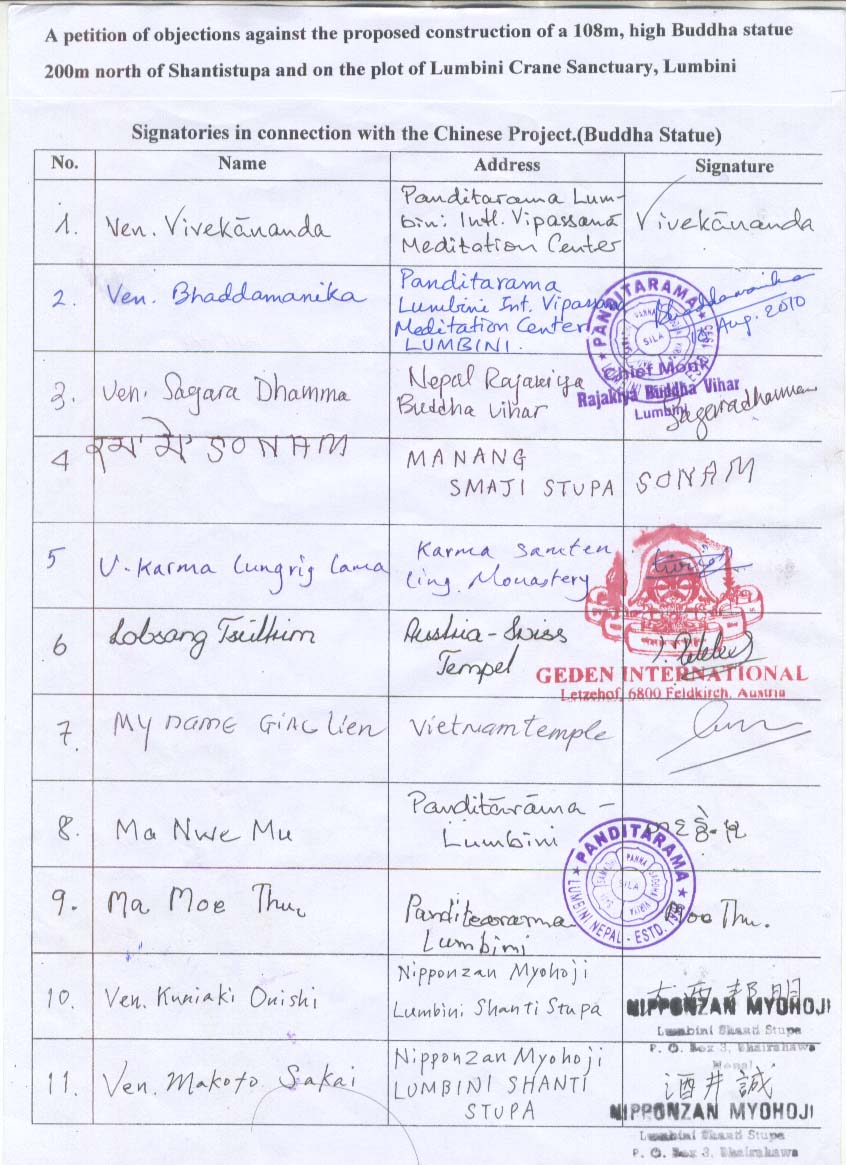
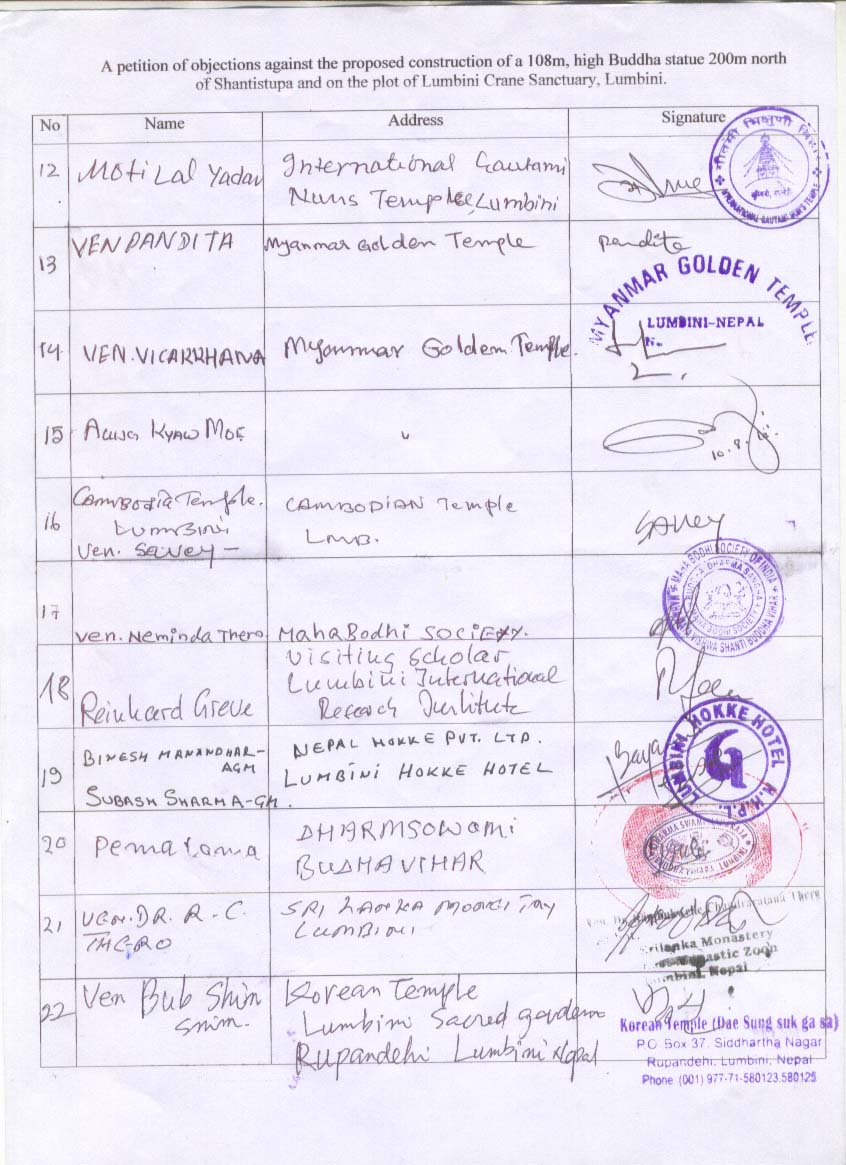
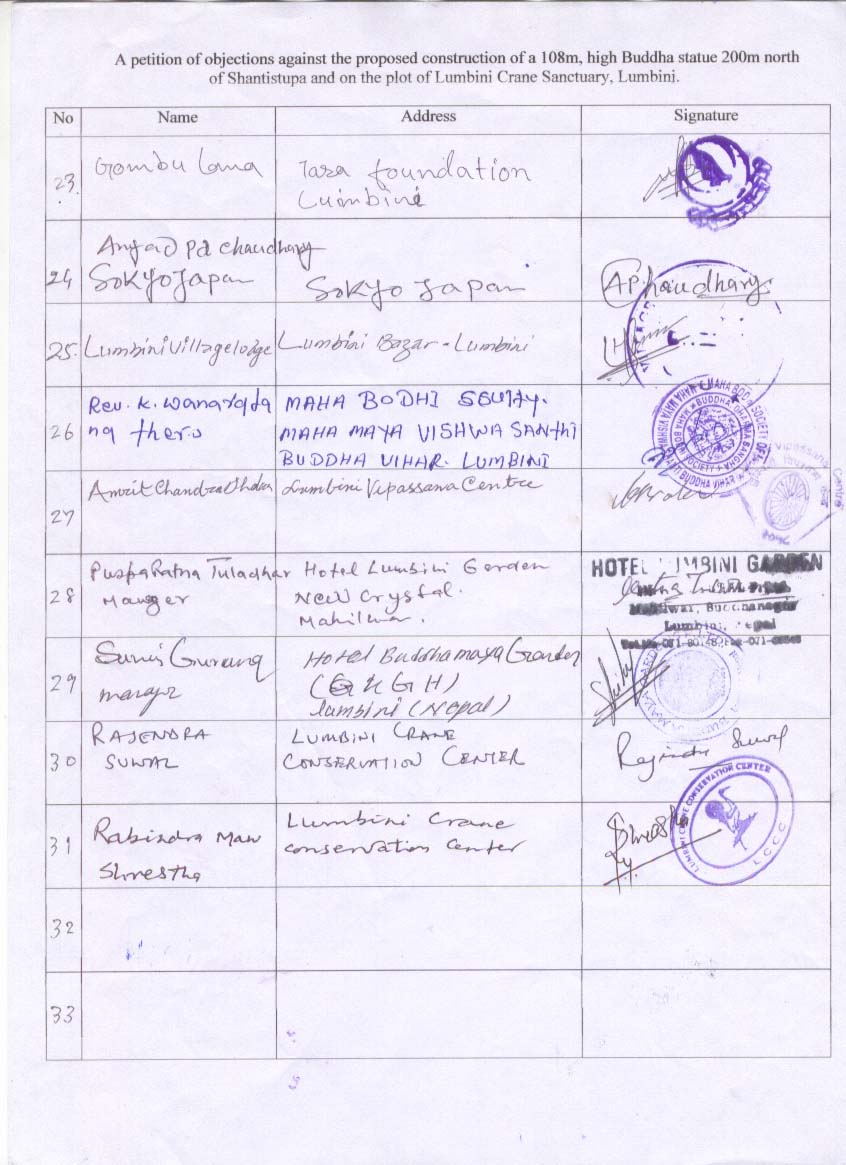
Petition of objections against the proposed construction of an 108 m high Buddha statue
[ more ]
5th of August, 2010
Lumbini Stakeholders Consultation on Emerging Issues
[ more ]

Petition against construction of an 108 m high Buddha statue:
Petition of objections against the proposed construction of an 108 m high Buddha statue 200 m north of Shanti Stupa and on the plot of Lumbini Crane Sanctuary, Lumbini.In November / December 2009 the Council of Ministers of the Government of Nepal assented to a major Chinese investment proposal for Lumbini. The proposed construction includes a five star hotel, a giant statue of Lord Buddha, a library, a research centre, and several museums. According to credible information received from Lumbini Development Trust (LDT) the 108m Buddha statue will be constructed within the Kenzo Tange Master Plan area on a plot of 480m x 480m just north of Nipponzan Myohoji’s Shanti Stupa.
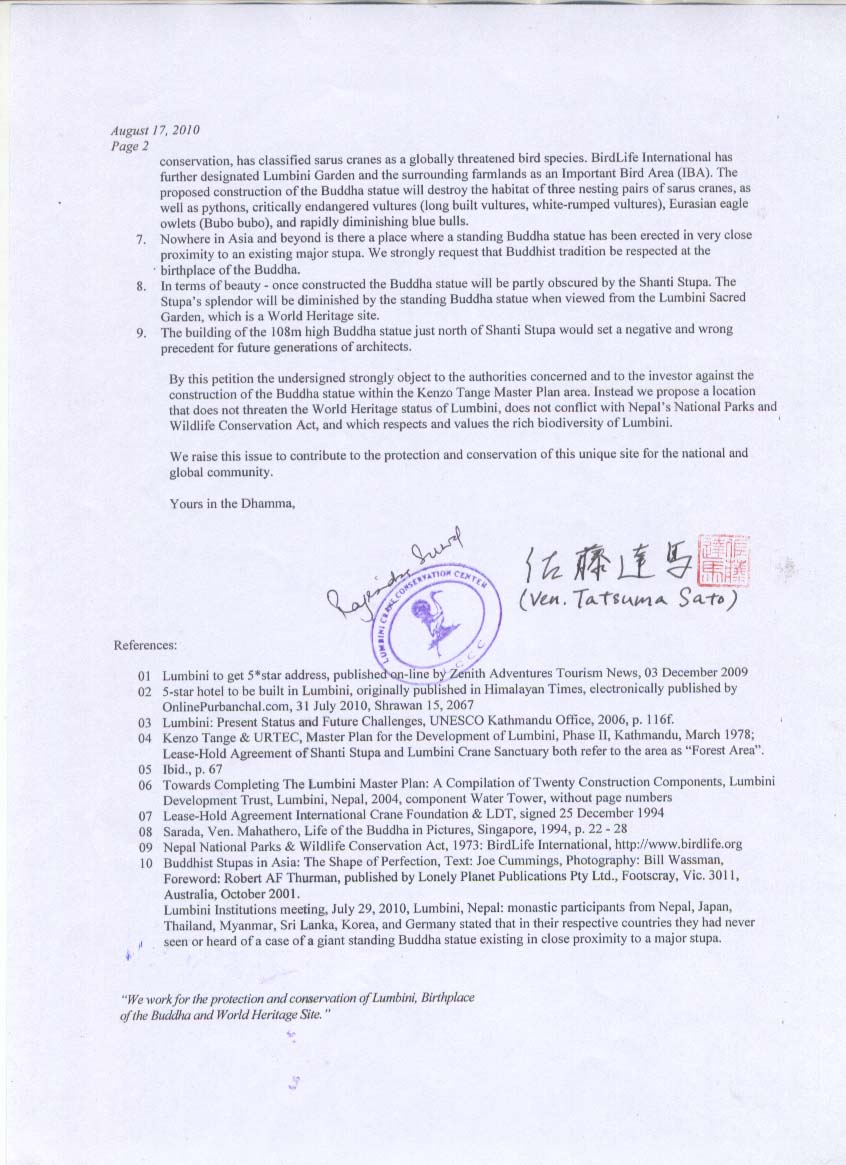
The undersigned would like to raise strong objections against the location of the proposed construction of a giant Buddha statue. The objections are as follows:
1. The Kenzo Tange Master Plan is a planning document that was approved in 1978 by the United Nations and the honorable Government of Nepal. The Kenzo Tange Master Plan for Lumbini is one of the documents submitted by the State Party (Nepal) to the World Heritage Committee prior to the inscription of Lumbini on the World Heritage List on December 6, 1997. The construction of a giant Buddha statue north of Shanti Stupa will drastically change the concept and functionality of the Kenzo Tange Master Plan. It will have an adverse impact on the Outstanding Universal Value of the World Heritage site Lumbini, particularly in terms of visual integrity.
2. The construction of a 108m high standing Buddha statue in the northern most part of the master plan area is not in accordance with the Kenzo Tange Master Plan (KTMP) for Lumbini. The KTMP calls for wooded area / grass land north of the New Lumbini Center, i.e. north of coordinate Y48.
3. The Kenzo Tange Master Plan calls for a height restriction of buildings in the monastic zone of not more than three stories. The tallest building in the master plan area is the water tower rising to a height of 33.06m from ground level. A 108m high Buddha statue would be more than three times higher than the tallest building in the area and does not fit into the concept of the Kenzo Tange Master Plan.
4. The 480m x 480m plot for the proposed construction of a Buddha statue is part of over 100 hectares of land that have been leased to the Lumbini Crane Sanctuary in an agreement signed by LDT and International Crane Foundation in 1994. This agreement is valid for a period of 50 years.
5. Historically Prince Siddhartha saved an injured Sarhans (sarus crane) shot by his cousin Devadatta, hence Lumbini is the perfect site to demonstrate the Buddha’s love for sarus cranes and nature conservation. Some of the objectives of the establishment of this Lumbini Crane Sanctuary are to protect the land for biodiversity conservation, to demonstrate the Buddha’s love for nature, to show the relevance of the Buddha’s teachings for nature conservation, and to demonstrate natural forest similar to forest during the Buddha’s period.
6. The sarus crane (grus antigone) and python are endangered species and are protected by the Nepal National Parks and Wildlife Conservation Act, 1973. BirdLife International, an international authority on bird conservation, has classified sarus cranes as a globally threatened bird species. BirdLife International has further designated Lumbini Garden and the surrounding farmlands as an Important Bird Area (IBA). The proposed construction of the Buddha statue will destroy the habitat of three nesting pairs of sarus cranes, as well as pythons, critically endangered vultures (long built vultures, white-rumped vultures), Eurasian eagle owlets (Bubo bubo), and rapidly diminishing blue bulls.
7. Nowhere in Asia and beyond is there a place where a standing Buddha statue has been erected in very close proximity to an existing major stupa. We strongly request that Buddhist tradition be respected at the birthplace of the Buddha.
8. In terms of beauty - once constructed the Buddha statue will be partly obscured by the Shanti Stupa. The Stupa’s splendor will be diminished by the standing Buddha statue when viewed from the Lumbini Sacred Garden, which is a World Heritage site.
9. The building of the 108m high Buddha statue just north of Shanti Stupa would set a negative and wrong precedent for future generations of architects.
By this petition the undersigned strongly object to the authorities concerned and to the investor against the construction of the Buddha statue within the Kenzo Tange Master Plan area. Instead we propose a location that does not threaten the World Heritage status of Lumbini, does not conflict with Nepal’s National Parks and Wildlife Conservation Act, and which respects and values the rich biodiversity of Lumbini.
We raise this issue to contribute to the protection and conservation of this unique site for the national and global community.
References:
01 Lumbini to get 5*star address, published on-line by Zenith Adventures Tourism News, 03 December 2009
02 5-star hotel to be built in Lumbini, originally published in Himalayan Times, electronically published by OnlinePurbanchal.com, 31 July 2010, Shrawan 15, 2067.
03 Lumbini: Present Status and Future Challenges, UNESCO Kathmandu Office, 2006, p. 116f.
04 Kenzo Tange & URTEC, Master Plan for the Development of Lumbini, Phase II, Kathmandu, March 1978; Lease-Hold Agreement of Shanti Stupa and Lumbini Crane Sanctuary both refer to the area as “Forest Area”.
05 Ibid., p. 67
06 Towards Completing The Lumbini Master Plan: A Compilation of Twenty Construction Components, Lumbini Development Trust, Lumbini, Nepal, 2004, component Water Tower, without page numbers
07 Lease-Hold Agreement International Crane Foundation & LDT, signed 25 December 1994
08 Sarada, Ven. Mahathero, Life of the Buddha in Pictures, Singapore, 1994, p. 22 - 28
09 Nepal National Parks & Wildlife Conservation Act, 1973: BirdLife International, http://www.birdlife.org
10 Buddhist Stupas in Asia: The Shape of Perfection, Text: Joe Cummings, Photography: Bill Wassman,
Foreword: Robert AF Thurman, published by Lonely Planet Publications Pty Ltd., Footscray, Vic. 3011, Australia, October 2001.
Lumbini Institutions meeting, July 29, 2010, Lumbini, Nepal: monastic participants from Nepal, Japan, Thailand, Myanmar, Sri Lanka, Korea, and Germany stated that in their respective countries they had never seen or heard of a case of a giant
standing Buddha statue existing in close proximity to a major stupa.
|