
Lumbini Crane Conservation Center
A joint effort between Nepalese Crane Conservationists and International Crane Foundation, USA

Highlights
August 17, 2010
Petition of objections against the proposed construction of an 108 m high Buddha statue
[ more ]
5th of August, 2010
Lumbini Stakeholders Consultation on Emerging Issues
[ more ]

Sarus Crane:
Identification:
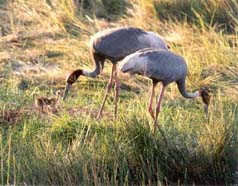
This is the tallest crane species standing at six feet tall, with a wingspan of eight feet. Body plumage is light gray. The crown is covered with smooth greenish skin. The rest of the head, throat, and the upper neck are covered with rough orange/red skin. The ear is marked by a small area of grayish white feathers on each side of the face. Long, black hair-like bristles cover parts of the upper throat and neck. In the Sarus Crane G. a. antigone, white feathers form a collar in between the bare reddish skin of the upper neck and the gray feathers of the lower neck. Legs and toes are a shade of red. Males and females are virtually indistinguishable but within pairs, females are usually smaller than males.The heads of juveniles are covered with cinnamon brown feathers, and the grayish ear patch is not yet obvious. Body plumage changes from cinnamon brown to gray as the bird matures.
Range:
The current range of the Sarus Crane G. a. antigone includes the plains of western half of Nepal’s Terai Lowlands.Habitat & Ecology:
Sarus cranes are mostly non-migratory bird, but often make short seasonal movements between dry and wet season. The Sarus Cranes G. a. antigone have adapted to the dense human population, and interact closely with people in areas where traditions of tolerance prevail. Throughout their range Sarus Cranes utilize a wide variety of landscapes, depending on food availability, cropping patterns, and other seasonal factors. Their optimal habitat includes a combination of small seasonal marshes, floodplains, high altitude wetlands, human-altered ponds, fallow and cultivated lands, and rice paddy. Often they focus their foraging on underground tubers of native wetland vegetation such as Eleocharis spp. Breeding pairs place their nests in a wide variety of natural wetlands and along canals and irrigation ditches, beside village ponds, and in rice paddies. Compared to other crane species, Sarus Cranes will utilize open forests where wetlands occur as well as in open grasslands more so than other crane species. Where possible, the nests are located in shallow water where short emergent vegetation is dominant.Mated pairs of cranes, including Sarus Cranes, engage in unison calling, which is a complex and extended series of calls where male and female vocalizations differ but are coordinated. The birds stand in a specific posture, usually with their heads thrown back and beaks skyward during the display. In Sarus Cranes the female initiates the display and utters two calls for each male call. The male always lifts up his wings over his back during the unison call while the female keeps her wings folded at her sides. All cranes engage in dancing, which includes various behaviors such as bowing, jumping, running, stick or grass tossing, and wing flapping. Dancing can occur at any age and is commonly associated with courtship, however, it is generally believed to be a normal part of motor development for cranes and can serve to thwart aggression, relieve tension, and strengthen the pair bond.
Nests of all Sarus Cranes consist of wetland vegetation. Unlike some cranes, Sarus Cranes breed throughout the year, except in May and June. Females usually lay two eggs and incubation (by both sexes) lasts 31-34 days. The male takes the primary role in defending the nest against possible danger. Chicks fledge (first flight) at 85-100 days.
Diet:
All cranes are omnivorous. Sarus Cranes feed on aquatic plants such as tubers of sedges (such as Eleocharis spp.), invertebrates, grains, small vertebrates, and insects.Threats:
Wetland loss and degradation are critical problems throughout the range of Sarus Cranes. Destruction of wetlands due to agricultural expansion, however, is increasing dramatically and poses a significant threat as well. These threats reflect increasing human population pressures.The future of the Sarus Crane is closely tied to the quality of small wetlands in India that experience heavy human use, such as; high rates of sewage inflow, extensive agricultural runoff, high levels of pesticide residues, and intensification of agricultural systems. Cranes have died due to pesticide poisoning.