
Lumbini Crane Conservation Center
A joint effort between Nepalese Crane Conservationists and International Crane Foundation, USA

Highlights
August 17, 2010
Petition of objections against the proposed construction of an 108 m high Buddha statue
[ more ]
5th of August, 2010
Lumbini Stakeholders Consultation on Emerging Issues
[ more ]

Cranes of the world
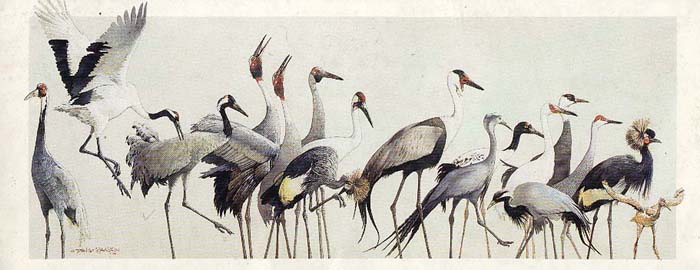
There are fifteen species of cranes found in the world. Cranes belong to the order Gruiformes, and the family Gruidae. The crane family (Gruidae) is divided into two sub-families, the Crowned Cranes (Balearicinae) and the Typical Cranes (Gruinae), Crowned Cranes are distinguished from Typical Cranes by their lack of a coiled trachea, their loose body plumage, and their inability to withstand severe cold. They retain the ability to roost in trees, and are only the cranes able to do so. Their calls are also simpler than those of the Typical Cranes
| Sn. | Scientific name | Common name | IUCN category | CITES list |
| 1. | Balearica pavonina | Black Crowned Crane | Vulnerable | Appendix-II |
| 1.1 | B. p. pavonina | West African Crowned Crane |
Endangered | |
| 1.2 | B. p. ceciliae | Sudan Crowned Crane | Vulnerable | |
| 2. | Balearica regulorum | Grey Crowned Crane | Vulnerable | Appendix-II |
| 2.1 | B. r. gibbericeps | East African Crowned Crane |
Vulnerable | |
| 2.2 | B. r. regulorum | South African Crowned Crane |
Endangered | |
| 3. | Anthropoides paradisea | Blue Crane | Critically Endg. | Appendix-II |
| 4. | Anthropoides virgo | Demoiselle Crane | Lower Risk | Appendix-II |
| 5. | Bugeranus carunculatus | Wattled Cranee | Endangered | Appendix-II |
| 6. | Grus leucogeranus | Siberian Crane | Endangered | Appendix-I |
| 7. | Grus canadensis | Sandhill Crane | Lower Risk | Appendix-II |
| 7.1 | G. c. canadensis | Lesser S.C. | Lower Risk | |
| 7.2 | G. c. rowani | Canadian S.C. | Lower Risk | |
| 7.3 | G. c. tabida | Greater S. C. | Lower Risk | |
| 7.4 | G. c. pratensis | Florida S. C. | Lower Risk | |
| 7.5 | G. c. pulla | Mississippi S. C. | Critically Endg. | |
| 7.6 | G. c. nesiotes | Cuban S. C. | Critically Endg. | |
| 8. | Grus antigone | Saurs Crane | Endangered | Appendix-II |
| 8.1 | G. a. antigone | Indian S. C. | Endangered | |
| 8.2 | G. a. sharpii | Eastern S. C. | Endangered | |
| 8.3 | G. a. gilli | Australian S. C. | Data Deficient | |
| 9. | Grus rubicundus | Brolga | Lower Risk | Appendix-II |
| 10. | Grus vipio | White-naped Crane | Vulnerable | Appendix-I |
| 11. | Grus monachus | Hooded Crane | Vulnerable | Appendix-I |
| 12. | Grus grus | Eurasian Crane | Lower Risk | Appendix-II |
| 13. | Grus americana | Whooping Crane | Endangered | Appendix-I |
| 14. | Grus nigricollis | Black-necked Crane |
Vulnerable | Appendix-I |
| 15. | Grus japonensis | Red-necked Crane | Endangered | Appendix-I |
There are two species: The Black Crowned Crane of the African Sahel Savannah from Senegal to Ethiopia, and the Grey Crowned Crane of the East African savannahs from Kenya to South Africa.
The Typical Cranes are divided into three genera: Anthropoides, Bugeranus and Grus. The Demoiselle Crane (Anthroides virgo) and Blue Crane (A. paradisea) have bustard like short toes and bills, and like the bustard live in grasslands.
Although the morphological features of the Anthropoides species and the Bugeranus carunculatus (Wattled Crane) are dramatically different. Studies of their behavior and DNA indicate a close relationship between them.
The Wattled Crane is a much more aquatic species. The species in the genus Grus are placed in five groups. The first group includes Sandhill Crane (Grus canadensis), which stand alone, as does the Siberian Crane (Gurs leucogeranus) in second group. The third group includes the Sarus Crane (Grus antigone), the Brolga (Grus vipio). The group of five consists of the Eurasian Crane (Grus grus), Whooping Crane (Grus americana), Hooded Crane (Grus monachus), Black-necked Crane (Grus nigricollis), and Red-crowned Crane (Grus japonenses).