
Lumbini Crane Conservation Center
A joint effort between Nepalese Crane Conservationists and International Crane Foundation, USA

Highlights
August 17, 2010
Petition of objections against the proposed construction of an 108 m high Buddha statue
[ more ]
5th of August, 2010
Lumbini Stakeholders Consultation on Emerging Issues
[ more ]

e-news :::November:::
The Breeding Sarus Crane in Lumbini
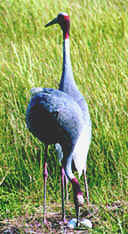 Sarus Cranes (Grus antigone) are most common and familiar bird species to most of the people from Lumbini and are always an intrinsic part of agriculture and wetlands, which live in harmony with rural farmers. They are the beautiful and world's tallest flying bird species, which are now globally endangered species. The estimated population of Sarus in Lumbini is around 150 to 200 and most probably it is the last significant population of Nepal. They have already been disappeared from eastern terai and very uncommon records from far-western terai. Lumbini Crane Conservation Center is only the non-government organization that is trying to preserve their existence in Nepal in affiliation with International Crane Foundation. Rajendra Suwal has dedicated for last fourteen years to conserve Sarus Crane in Lumbini.
 For this year our survey of nesting Sarus in Lumbini on August found eleven pairs with their eggs in nests. In an average, every year we record ten to fourteen pairs of Sarus with their nest in nesting season i.e. on August/September. When temperature reaches to a maximum degree in June/July (upto 40 to 45 degree centigrade), extreme heat plays as a stimulating factor stimulate their sex hormones. Then, they become pairing and try to find out some isolated places and appropriate habitats for nesting ground. Prior to nesting season, they roost in flock along the riverbed of Tinau, Dano and Telar. Upto eighty-four Sarus Cranes were recorded in one flock few, the average flock size ranges from twenty to fifty.
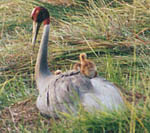 When breeding pairs separate from the flock and find safe nesting grounds, they start building their nest. Through out the whole nesting and hatching season and nourishing of their chicks, the pair remains same and lives together. Though female lays the eggs, both male and female incubate simultaneously. Incubation period is from thirty to thirty five days. Female lays two eggs at a time, if it is destroyed, stolen or abandoned by any reason, it can again lay two eggs for the second time. One female Sarus can lay eggs upto three times, if the eggs are vandalized by any way.
We again surveyed cranes to find out their hatching status after three months in November. We found six pairs, out of eleven nesting cranes, hatching their chicks successfully. The chicks have grown to two to three feet tall. Major problem of nesting Sarus is stealing of eggs and to some extent stealing of chicks as well. People, mostly children, take the eggs for eating purpose. Most of the people around Lumbini are under poverty line. Thus, because of their extreme poorness they prefer to have eggs by stealing rather than buying. Since, the size of the eggs of Sarus is nearly five times larger than the eggs of Hen, people are more tending to steal.
To mitigate such numerous problems of Sarus Crane conservation, LCCC has been tirelessly implementing different conservation tools like Annual Environment awareness camp for school students, Weekly bird-watching hike for students and local youths, Art competition on Crane and nature; broadcasting of local Radio FM for biodiversity conservation awareness to people from village to urban area and from civilians to concerned officials; promoting community managed wetland through user groups to preserve wetland for cranes and to generate income for people by fishery, horticulture, apiary; and establishing tree nursery for user groups to restore natural habitat and to enhance income generating activities of locals.
Appreciating our dedication and enthusiastic spirit to work in conservation initiatives, UNDP-GEF/Small Grants Programmme has recently shown their attention and graciously granted us to enhance our conservation activities in Lumbini and Rupandehi district. Similarly, International Crane Foundation, USA, Vanderbilt Family Foundation, Keidanren Nature Conservation Fund and King Mahendra Trust have always remained as our part of conservation initiatives. The contribution of Ecosystem Conservation Society-Japan to protect farmland-biodiversity, conservation awareness and wetland management in Rupandehi district is memorable to the local people. LCCC is always grateful to Lumbini Development Trust for its kind cooperation and moral support, without which all these conservation initiatives could not be success. We are also indebted to Mr. Ronald Crosier from USA for his genuine support to our ongoing activities. Very recently, Canadian Cooperation Office, Pacific Asia Travel Agency Association and Tourism for Rural Poverty Alleviation Project have shown their keen interest to boost our conservation activities in Rupandehi district.